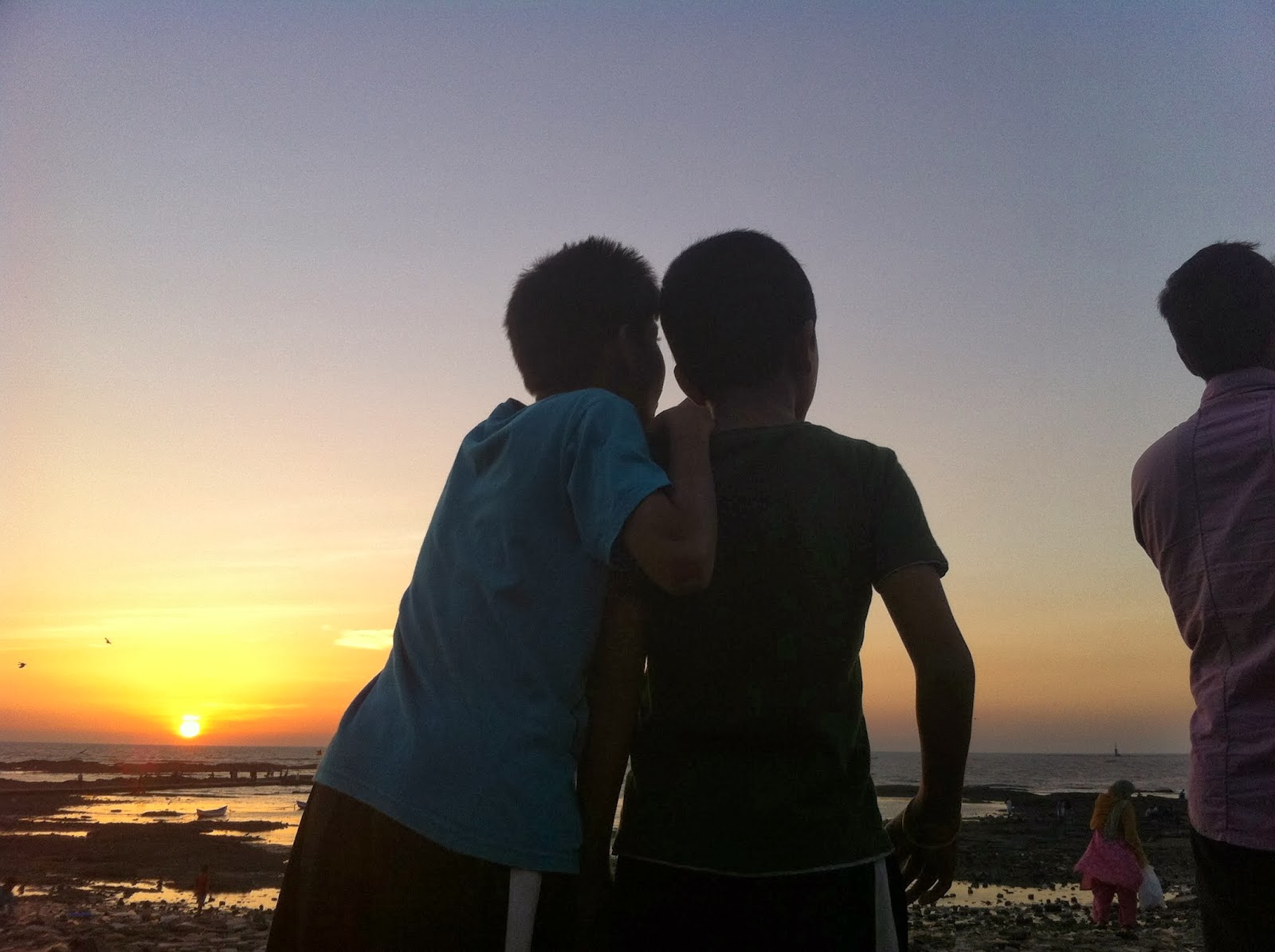
27 January 2016

Today in Mumbai

Wow. While walking through Khar Danda this morning, past an area where a local mechanic keeps some junk cars parked, I heard the familiar strains of, "Uncle, Uncle!", in plaintive, muffled, high-pitched voices. That's what the local kids call me, call many older men, out of respect. 
At first I thought it was in my head, as when a song you've been listening to repeatedly starts to play on its own. I hear that refrain often, from neighbours and strangers. I stopped and looked around anyway, and didn't see kids tugging at my shirtsleeves as I half expected. There were just a few men working nearby. 
Then I saw the shell of a car next to me. No wheels, but cabin and windshields intact. And inside were two small children, banging their fists against the glass. I walked closer and saw their dusty faces streaked with tears, their mouths twisted into pleas. 
I walked around to the passenger side and opened the door. The kids poured out. The inside door panels had been removed. They had entered the car to play, and couldn't get out. I don't know how long they were in there. 
I followed one boy as he ran to his nearby dwelling, the kind of small shack, with tarp flaps for a door, that is common in this fishing village neighbourhood of Bombay. His mom was squatting outside, washing dishes in a bucket. He was explaining to her what happened. 
I don't think they were locked in there for a long time. Though no one was close enough to hear them, it's a busy street with people passing frequently. Surely someone would have heard them eventually. But they were pretty freaked out when I opened the door, and ran away from that car as fast as they could. I don't think they'll be playing there again. 

10 March 2015

Privileged but not Entitled

Recently, I was taking a walk through the city streets on a busy weekday late afternoon. Traffic lights here are exceedingly rare, reserved for only the most traveled and convoluted intersections, and stop signs are virtually nonexistent and universally ignored.

The way it works is something like what happens at a 4-way blinking yellow light in the States, but far more chaotic; each vehicle slows down as little as possible, beeps like an angry sheep, and tries to avoid being hit by cross traffic. This applies to pedestrians, bicycles, motorcycles, three-wheeled autorickshaws, small cars, big cars, small trucks, big trucks, and the occasional fisherman on horseback. As per tradition, the largest vehicle has the right of way, and pushes itself through with a deep beeping that is more threat than warning. When a rickshaw does find a gap, it moves in deftly, followed quickly by others close on his tail, as if they could create a new vehicle, a serpentine train that collectively could overpower the trucks and cars. Fortunately for pedestrians, these vehicular exchanges often result in a stalemated gridlock, and those on foot can easily scurry across.

So I was walking around, and came to an intersection. From the right, a fancy car was approaching. From the left you could hear a siren, and then an ambulance came into view.

In the US, of course, cars generally get out of the way of ambulances (although I have seen drivers in LA freeze sometimes in the middle of intersections, unsure of what to do). But here, to some, an ambulance is just another vehicle. I stood and watched as the car coming from the right cut in front of the ambulance and came to a stop in front of a shop, blocking the ambulance (and other vehicles) from moving past. Out of the back seat a well-dressed young woman emerged, on her mobile phone, seemingly unaware of anything around her. I was a little shocked. It was like no one else existed, or mattered.

I have encountered this sense of entitlement before in Mumbai. Only a few days before, I was standing at my favourite local street dosa stand, ordering a delicious dosa, when a similarly new and expensive car pulled up right behind me. Out from the car emerged what we call an India Auntie; a woman in her 50s or 60s, well dressed, exuding an air of self-importance. She pushed me aside (not kidding) as if I wasn't there, and started barking orders to the dosa chef inside the stall. No one else in the world mattered.

Where does this come from? It''s related to the extreme class (and caste) differences here, where some of the wealthy are used to having lower caste cooks, drivers, maids, and other workers catering to their every whim.

As a foreigner, I realize I have privileges that are unknown to some locals. Although there are times that I'm charged more for things than locals, in general, I have access to opportunities that some locals simply never will have. From the ability to splurge on good meals and imported candy, to the demand for voiceover artists with American accents, to easy admission to clubs and shops, I can go places and see things that many locals never could.

I only hope, despite this privilege, that I don't cross over into entitlement. I hope I can appreciate the ways in which I'm fortunate while never taking it for granted, or taking it out on those in a less privileged position.

There is a story of a teacher who sat his students in rows, put a garbage can at the front of the room, and told his students to ball up a piece of paper. He then announced that anyone who could throw the paper into the garbage in one throw would get an A for the semester. As the paper started flying, the students soon realised that those in the front row had a much easier time hitting the garbage can, and the further back in the class the student was, the harder the task was. Not everyone in the front made it, and not everyone in the back missed, but it was clear where the advantage was. Only the students in the back complained. The students in the front were focused on their goal.

The teacher told the class that's what privilege is like. It's not a guarantee of anything, but it gives some a head start, and makes it harder for others to achieve the same. “Your job", the teacher said, " — as students who are receiving an education — is to be aware of your privilege. And use this particular privilege called “education” to do your best to achieve great things, all the while advocating for those in the rows behind you.”

I realise I'm at an advantage in some ways being a white foreigner here with a clean English accent. I appreciate that fact that it's easier for a Westerner to come to India than the other way around. I acknowledge my privilege, and will use it to be the best I can be. But I hope I never become complacent about it, and I hope I never feel entitled to that privilege.

And now, some pictures from Holi.I played colours in my old neighbourhood of Khar Danda, and then we had a little party on our terrace at home. Holi really is such a sweet holiday, the way friends and strangers approach you and gently apply colour to your cheeks. Adults drink and dance, teenagers flirt, children run around. Courtyards of neighbours gather, play music, and prepare communal meals, and everyone lovingly douses each other in water and colour.


20 February 2015

Bombackground

Dream on; dream until your dreams come true.
– Steven Tyler

If one advances confidently in the direction of his dreams, and endeavors to live the life which he has imagined, he will meet with a success unexpected in common hours. 
–Henry David Thoreau


This summer will be the 20th anniversary of my first trip to India. In the late summer of 1995, I quit my teaching job, bought a backpack, a combination lock, and a Swiss Army Knife, and headed to the other side of world. 

I grew up in South Florida and was raised within Conservative Judaism (which is not a political signifier- my parents were quite liberal actually- but refers to American Jews whose religious practice falls somewhere between orthodoxy and secularism).  As the grandson of a Rabbi I went to Hebrew school for 8 years and became a bar mitzvah at the age of 13. Religion was an important part of my life, and while there were certainly many years of rebellion, by the time I went to University, it was a subject with which i was fascinated. I was not asinterested in studying the religions of the world from the outside; I was much more interested in religious and spiritual experience- what it's like for the practitioner; the experience of the mystic. I studied physics, philosophy, psychology, and religion, and after a glorious 5 1/2 years of erudition, enjoyment, and enlightenment, I graduated with a degree in religion. 

I then moved to California, in the summer of 1990, and went to graduate school in Interdisciplinary Consciousness Studies. The program has since changed a bit, but it was an academically rigorous attempt to reestablish phenomenology as a way to gather knowledge about nonphysical aspects of human experience. Put simply, it recognized that there is more to life than the physical world, and that even though science can't study them, such experiences can be studied in a scientific way, by acknowledging the role of subjectivity. We looked at the role the observer plays in quantum physics, mystical or spiritual experiences and their effects, alternate states of consciousness like dreams, out of body experiences, and psychedelic experiences, and other ways in which the individual can influence experience. 

Science, you see, has turned out to be a terrific way of learning about the physical world, but is not a complete description of human experience. By definition, the individual scientist shouldn't have an effect on the results of any experiment. Two scientists should have the same results if they do the same experiment, and in that way, we learn what rules about the physical world are universal. Who the individual scientist is, what her history and expectations are, should not matter at all.

But we all know that individuals can and do bring a lot to any situation.Who we are, what our history, emotions, and expectations are can drastically effect our experience of a situation. So clearly, there is more to human life than that which can be explained with science. That's what we studied.

 Although I had been introduced to the religions of India as an undergrad, as a graduate student I studied them, and south Asian religious history, more extensively. I grew to love the subject and that part of the world, especially due to teachers such as David Komito and Vernice Solimar

After grad school, I started teaching middle school math and science, but after a few years the pull I was feeling grew inescapably compelling, and I left that school, and headed off to India.

That first trip, in the fall of 1995, was magical. From the moment I landed, I felt at home. It was (and remains) difficult to explain, but I felt so comfortable and happy among the chaos and beauty. On that trip, which lasted 3.5 months, I saw a total solar eclipse, went on a 10-day Tibetan Buddhist meditation retreat in the hills above Dharamsala, had a brief affair with a young woman from Sweden, visited the birthplace of Lord Krishna, met many lovely people, and ate a lot of great food. I got sick a couple of times, and there are always frustrating and difficult moments traveling here, but I loved every minute of it.

Twenty years and a few more trips later, I have returned to live here in Bombay, aamchi Mumbai, the 8th biggest city in the world, the most progressive and populous city in India, Maximum City, the City of Dreams, to call myself a Mumbaiker, to make this incredible place my home. I do realize how fortunate I am. I am grateful every day.

What will happen? Will I stay 6 months or 6 years? Will I teach music, do voiceovers, appear in Bollywood movies? Will I find love? So many mysteries lie ahead. I'm ready for the unfolding. I surrender to you, mother India. Take care of me, as you always have. Return my love, as you always have. 

This should be interesting...

09 March 2014

Photographic Interlude

Sunset at Carter Road, Mumbai

Namaste hands in Ahmedabad

Snack Wallah

Locals at rest stop in Gujarat

Desert Festival Parade in Jaisalmer


Entrants in the Mr. Mustache competition

Mr. Desert and me

Jaisalmer view from fort

Sunset over Jaisalmer


A boy and his camel


Sunset at the Cenotaphs at Bara Bagh

Bara Bagh

Bara Bagh

Bara Bagh

Local friend at Bara Bagh

Sunset at Bara Bagh

Sunset from Bara Bagh

Holy Cow

Wall detail near Shiva Temple, outside Jaisalmer

Shiva Temple

Ceiling of Shiva Temple


Rickshaw Driver at Shiva Temple

Clown at Car-Free Day on Carter Road

Sunset panorama at Juhu Beach, Mumbai

Hair Salon. Like the name?

Oscar the Cat.

27 February 2014

The Rhythm of the City

I was feeling the rhythm of the city today. The trick is to get out early, have a leisurely breakfast, get some work done, and then return home to escape the heat of the day for a few hours. Then, at 5 or so, head out again, and enjoy the Mumbai evening. Today, I did leave my room early, mostly because I was asked to, in order for the maid who clean the apartment I"m staying at could get in, change my sheets, and tidy up a bit. It's a little weird, but she comes with the apartment, and that's how it's done here. So I went out for coffee and breakfast at a place called Mochamojo nearby. It's done up in full 70's decor; vinyl booths that look like the back seat of old cars, bean bag chairs, end tables that look like Rubik's Cubes. The coffee was quite good, and for breakfast I had basically a Spanish tortilla; eggs and potatoes baked together in a pie. Over breakfast, I had a long phone call with Sonali, whom faithful readers will remember as the head of Dreamcatchers NGO, and who is getting used to the idea of becoming a mentor for younger people who are called to service but don't know how to begin. Truly, she's been a mentor for many for a long time, and is one of the most inspirational people Ive ever met, but of course no one sees themselves from the outside quite as others see them.
From there, I did go home for a few hours. The last few days have been very hot and humid, although it's still quite pleasantly cool in the evenings. I left a little earlier than usual though, and headed up to Juhu, the part of town a little further north, with its wonderful beach and grand Hare Krishna temple. The last time I was there, I discovered, around the corner from the temple, a Thai massage shop, and I went back and treated myself. The first time, I got a traditional Thai massage, and this time I opted for the classic Swedish. Sixty minutes, as professional as you'd want, for US$20. I could get used to it.
After the massage, I went to the Krishna temple, one of my favorite spots in the city. It's a whole complex, with a hotel, restaurant, snack stalls, library, and other services, but the centerpiece is a giant, white marble temple which displays all the grandeur and beauty befitting Lord Krishna and his consort Radha. The statues of the deities are lovingly cared for by a crew of volunteers, who dress them, cover them in flower garlands, and burn sweet-smelling incense to please them. All the while, devotees chant Krishna's name in the background, and we all join in, call-and-response style. I love going to the temple. It's a beautiful, peaceful place to give thanks for being here, for being alive, and it's always among the first and last places I go when I visit this country.
A new baby Krishna light I got at the temple.

From there, I headed to the nearby Juhu beach, which is always crowded with locals and Indian tourists who bring their entire families and baskets full of food. Some people swim, some sit together on the beach, lovers stroll along the shore, and children run and play freely. I watched the sun set over the Arabian Sea, ate some Pav Bhaji, and when it was dark, headed to my old neighborhood of Khar Danda.
There, I visited my old friend Sachin the saloon-keeper, for it was time for my weekly shave. And then I visited my old neighbors, the DJ brothers Sachin and Pravin. They were not actually there, but their sister and father and uncle were there, and I hadn't seen their father since I've been back, so it was great to catch up with him. He's had a really rough year, losing his wife and a younger brother within a few months. (I told him I understood.) And now, his daughter Poonam must take care of the father and the two brothers, because they are a poor village family, and that's how it's done. I wish she had the freedom to leave, continue her education (she did finish college), find a husband of her own, but they are a traditional family, and with the mom gone, she feels it is her place to take care of her father. She's perfectly happy though, and thinks it's weird that American families don't stay together forever and are scattered around the country. Indian families stay together, she says, and who am I to say that's wrong. It seems like she's happy with the decision, and doesn't feel forced into it, although it's hard to tell because in some ways it's expected of her. But she says she would choose to do it, even if she did really have a choice, and she certainly seems happy.Not everyone has to become a big shot or become super-productive at business. There's something to be said for a quiet, simple life, too.
From there, I tried to take the bus home, but I must have missed my stop, because before I knew it, I was at the last stop, the Bandra railway station. No problem. I hopped in a rickshaw and headed home. My apartment is near a Bollywood film studio called Mehboob Studios, and it's a great landmark that all the drivers know. I locked up the gate, as I do each evening, and headed upstairs. All in all, a great day in the city.

Tonight's sunset at Juhu Beach:


I was sitting at my desk today when the ceiling fell on my head

Cyclone Tauktae I live in a rooftop apartment, so every year before the monsoons, my roof needs some work done. Mostly they patch the holes ...